We have a nasty habit in tech, every time we ship something that makes life easier, fraudsters find a way to make fraud easier too. That pattern has repeated itself since the web went public in the 1990s, and it is about to accelerate again thanks to open-source AI.
A thirty-year pattern
Look at the big jumps:
| Year | What changed | Immediate fraud response |
|---|---|---|
| 1995 | Web browsers land on every desk | First phishing emails and auction scams |
| 2002 | Broadband everywhere | Spam jumps from 8% to 60% of email in two years |
| 2007 | iPhone & Android | Malicious apps, SMS phishing, mobile click-fraud |
| 2013 | Cloud goes mainstream | Target, Yahoo, Adobe mega-breaches |
| 2017 | Cheap exploit kits & crypto | Ransomware, 3ve/Methbot ad botnets |
| 2023 | Open-source LLMs | AI-written phishing, deepfake voice scams |
Each leap gave criminals fresh reach or fresh speed. The cost of cyber-crime has tracked the curve, roughly doubling every five to six years and now sitting near $8 trillion a year.
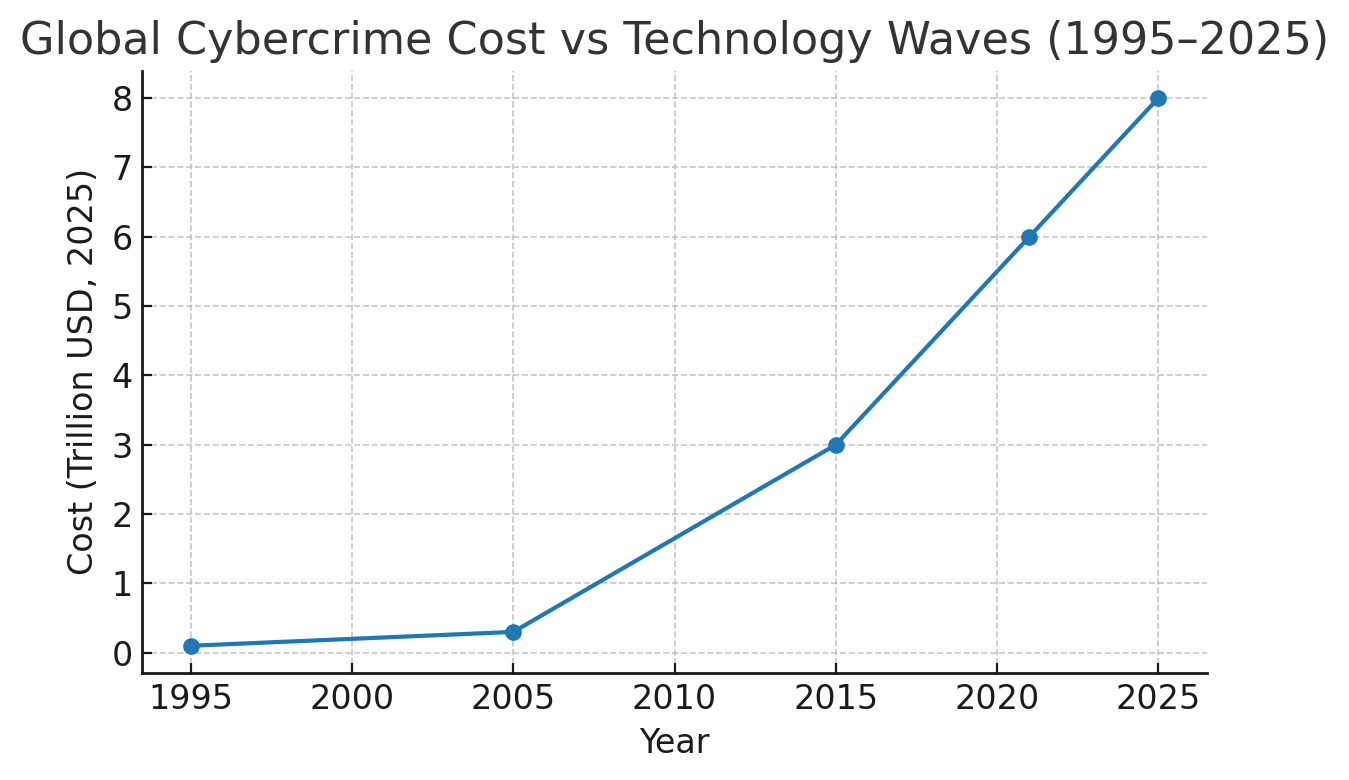
*Source: multiple industry reports adjusted to 2025 USD.*
TL;DR: Every major tech leap has given criminals new tools - and the pattern is accelerating with open-source AI making fraud creation essentially free.
Why AI changes the maths
Open-source language models are the next step on that acceleration curve:
The AI Difference:
- • No gatekeepers – run the model on a laptop, no API key, no audit trail
- • Hyper-personalised scams – an LLM can write 10,000 bespoke phishing emails before breakfast
- • Synthetic identities on tap – full name, back-story, phone, even a deepfake selfie, all generated in seconds
If you buy leads or ad impressions, the cost of faking all that data just fell close to zero.
How bad could it get?
Industry forecasts already had ad-fraud hitting $172 billion a year by 2028. Factor in autonomous AI agents and the numbers look worse.
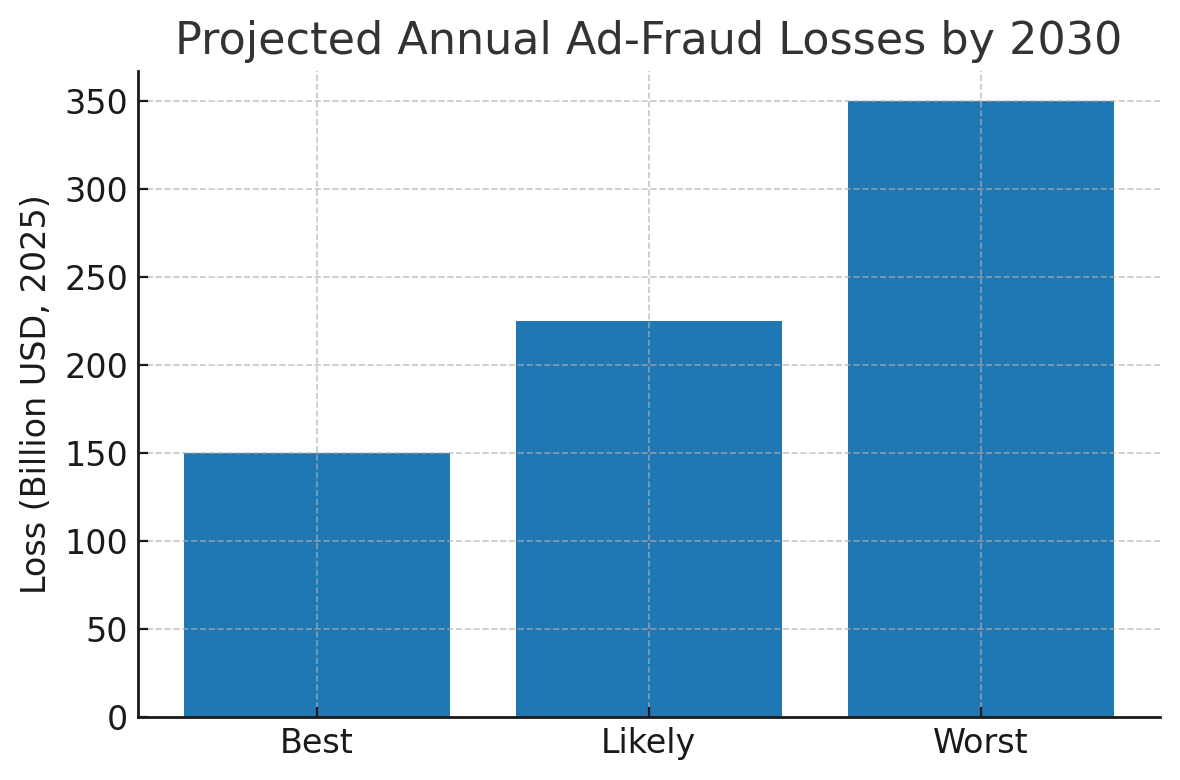
*Best-, likely- and worst-case scenarios.*
The Three Scenarios:
- • Best case – collaboration and tough verification keep fraud near 15% of spend
- • Most likely – we muddle through, fraud takes roughly a quarter of every ad pound
- • Worst case – a third of global ad budgets end up in bot farms and fake sites
What stops the slide?
Defence Strategies:
- • Real-time, layered verification of every lead and every ad impression
- • AI on defence – graph-based risk scoring that spots synthetic patterns as they appear
- • Industry transparency – shared block-lists, auditable log-files, proper refunds when fraud leaks through
- • Zero-trust data architecture – encrypt the lot, segment the lot, assume breach
- • User tools that expose fakes – deepfake detectors in the browser, single-click voice validation
Waiting for regulators is not an option. History shows they arrive years after each wave, by which time the damage is done.
TL;DR: Defence must move at machine speed - automated verification, AI-powered detection, and real-time data sharing are the only ways to keep pace.
The bottom line
Every inflection point...browsers, broadband, smartphones, cloud, has carried an unwanted passenger: a new breed of fraud. Open source AI is no different, only faster.
If you're buying data or ads, treat every inbound record as hostile until proven clean. If you're building the filters, build them to run at machine speed. For more insights, see our analysis on data breaches driving fraud and KYC database quality.
Ready to fight fraud at machine speed? Contact Provero to see how real-time verification can protect your business from AI-powered fraud.
Sources
1. FTC Spam Summit Report – spam rose from 8% of e-mail in 2001 to 60% by 2004.
2. FTC Consumer-Fraud Complaints 2001 – 204,000 complaints; 42% identity theft.
3. FTC v ChoicePoint Settlement – 145,000 records exposed; $15m fine.
4. Juniper Research – Digital Ad-Fraud Losses to Reach $172bn by 2028.
5. Cybersecurity Ventures – 2025 Official Annual Cyber-Crime Report – global losses timeline.
6. ENISA Threat Landscape 2023 – emerging AI-enabled threats.
7. Europol Strategic Insight – ChatGPT: Assessing the Threat – generative-AI misuse warning.
8. FTC Data Spotlight – Social Media Scams – one in four fraud losses start on social platforms.
Further reading on the site: