I have been working in lead generation since 2006, and verification has been part of the job from the beginning. Not because we were trying to create some grand theory about data quality. Because if the leads were bad, clients complained, invoices got challenged, and nobody kept buying.
At DMRI, where I started, verification was practical. It meant fewer complaints, fewer rejected leads, smoother month-end finances, and clients who kept buying. That was the whole pitch. Nobody in those rooms used phrases like "data quality strategy". You verified because the alternative was a difficult phone call on the last Friday of the month.


Nearly 20 years in lead generation will do that to you.
DMRI: verification as survival
In the early days, verification was not sold as a strategy. It was survival. Bad leads meant rejected invoices, angry clients and wasted sales time. Good verification meant fewer of those problems, and a business that could plan beyond the next month.
At first, I understood verification as a way to stop bad data causing immediate commercial pain. Stop the complaints, protect the revenue, keep the relationship. That was the limit of the ambition, and for a while that was enough.
Mediabowl: verification as competitive advantage
Later, at Mediabowl, verification became one of the ways the business grew. We did the standard checks, then built our own tools and rules on top. I spent hours looking through data, spotting anomalies and patterns that did not look right. Names that were almost human. Phone numbers that were almost real. Form fills that were technically valid but behaved like nothing a human would do.
The important shift in my thinking happened around then. We stopped just deleting bad records and started asking why they were getting in. Instead of removing the symptom, we began building systems that learned from each bad record so the next one would be caught earlier, or never accepted in the first place.
Eventually, clients started asking whether we could process leads they were receiving from other suppliers. When the data went through us it was cleaner and converted better than when they received it direct. That was the moment verification stopped being a back-office check for me and started looking like a competitive position.
Databowl: verification as infrastructure
When Databowl was built, the first clients were not advertisers buying leads. They were often other lead sellers who wanted the same advantage we had given to the buyers. They wanted to clean data, improve conversion, reduce rejections and prove quality to their own customers.
That was when verification stopped feeling like a tool and started looking like infrastructure. Something you build the rest of the business on, rather than something you bolt on at the end to tidy up the mess.
The bigger pattern
Over time, the same pattern kept showing up. The companies that cared about lead quality outlasted the ones chasing huge volumes of cheap data. The cheap-volume operators could look impressive for a while, but the economics usually caught up with them. Complaints rose. Conversion dropped. Clients left. The businesses built around better data tended to last longer, even when their headline numbers looked smaller.
The other thing I noticed was that verification was improving more than sales. It was affecting finance, operations, reporting, client relationships and trust. The dirty spreadsheet at the start of the process did not stay in the spreadsheet. It leaked into every conversation that followed.
The customer satisfaction question
For years, I thought about verification mainly through the lens of sales and marketing performance. Cleaner data meant more contactable leads, fewer complaints and better conversion. But eventually I started wondering whether the effect went further than that.
If verified data improves the first interaction, the follow-up, the service experience and the ability to resolve problems quickly, would it also show up in customer satisfaction? That was the question that led to the Verification Dividend.
Testing the idea
That led me to test the idea more formally. I looked at whether stronger customer verification practices were associated with better customer satisfaction outcomes, using public review data, verification adoption signals and supporting research. The result was not proof of causation, and I would not pretend it was. But it did show a clear correlation worth taking seriously: companies with stronger verification practices tended to have better customer satisfaction signals.
I had not seen the connection framed this way before. Verification was usually discussed as a cost saver, a compliance measure or a fraud prevention tool. The data suggested it might also be part of the customer experience story.
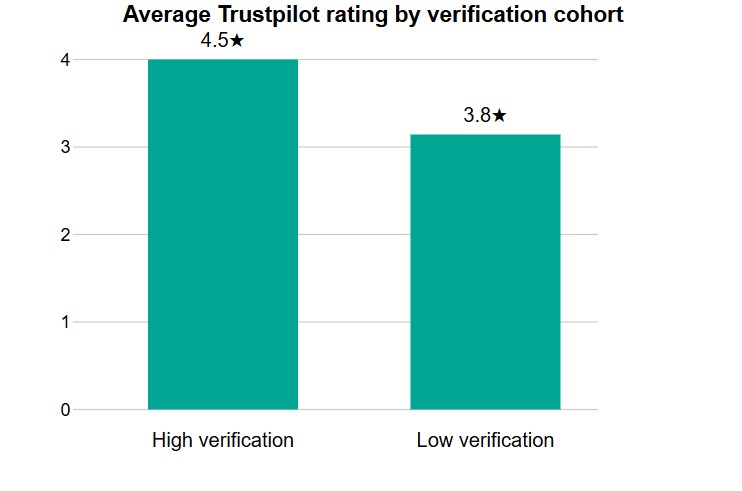
Average Trustpilot rating by verification cohort. Correlation, not proof of causation, but worth taking seriously.
A short definition
The Verification Dividend is the measurable gain a business gets when verified customer data improves what happens downstream: sales contact, marketing deliverability, operational efficiency, customer experience and trust.
The main article explains the concept in more detail. This article is about where the idea came from.
Why I gave it a name
I call it the Verification Dividend because it deserves a name. But the idea started long before the research. It started with rejected leads, angry clients, dirty spreadsheets and the simple realisation that better data changes the performance of everything built on top of it.
The older I get, the more obvious it seems. Bad data does not stay in the database. It leaks into sales, finance, operations, customer experience and trust. Verification is not just a way of cleaning up after the problem. Done properly, it stops the problem shaping the business in the first place.
Frequently asked questions
What is the Verification Dividend?
The Verification Dividend is the measurable gain a business gets when verified customer data improves sales contact, marketing deliverability, operations, customer experience and trust.
Where did the idea come from?
The idea came from nearly 20 years of working in lead generation and seeing the same pattern repeatedly: companies with better data quality usually performed better than those chasing cheap volume.
Is the Verification Dividend proven?
The research shows a correlation between stronger verification practices and better customer satisfaction signals. It does not prove direct causation, but the relationship is strong enough to be worth taking seriously.
How does this article differ from the main Verification Dividend article?
This article is the personal origin story. The main Verification Dividend article explains the concept, evidence and business impact in more detail.
For the fuller version of the argument, read The Verification Dividend: Why Verified Customer Data Pays Back Across the Whole Business.
You can find the dataset and methodology behind the study here: https://zenodo.org/records/15594099.
Background on the study itself is available at the Provero customer verification study page.